School portraits / Memories of the 1950s and 1960s
Left Off the Games List, He Told Nobody
At The Leys in the 1960s a clerical error freed one boy from compulsory games for a year, and he spent it in the school print room. When our son’s name went missing, I emailed the school at 7.02am.
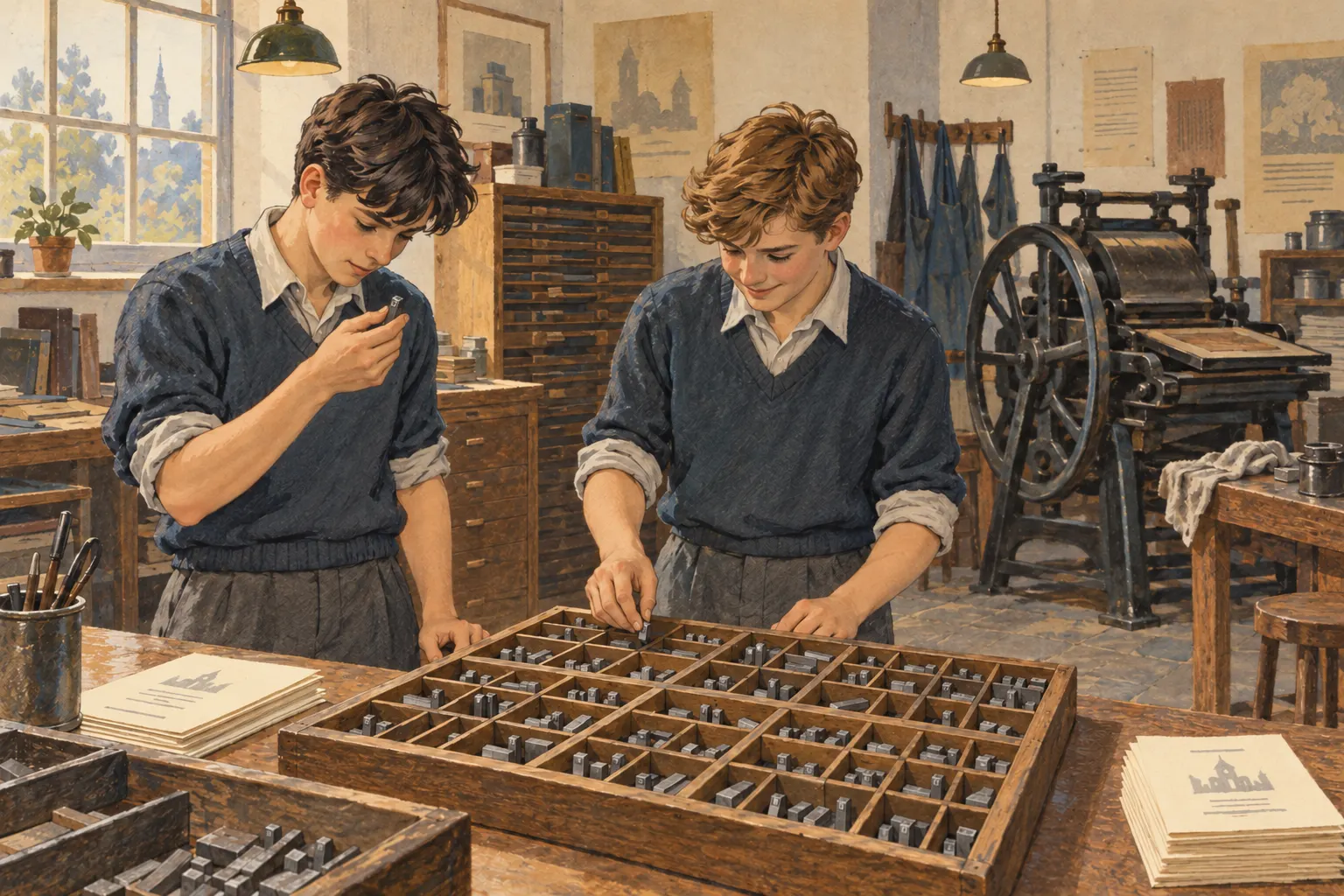
At the start of his final year at The Leys in Cambridge, Duncan Forbes scanned the noticeboards, where the lists put every boy in a team for that term’s compulsory afternoon games, and found that his name had been left off. He hated compulsory games. The omission, he writes, was “a gift from a benign providence which I exploited to the full.”
I would have reported it. I would have reported it before breakfast, with a screenshot.
Instead, every afternoon, he slipped down to the school press in the basement and got on with whatever was waiting: typesetting, cutting paper, designing, and “dissing”, which is putting the type back in its cases. The small jobs went on a Bremner treadle press, which meant standing on one foot, treadling with the other and using both hands to load and unload every sheet. That is more coordination than any games afternoon has ever asked of anyone, and he did it to get out of games.
The rest of the equipment would not pass a modern risk assessment. In the far corner stood an ancient guillotine with a blade about two and a half feet long and no guard at all; he once cut a large screwdriver in half with it without noticing. By the door was an elderly Heidelberg automatic press which, when switched on, made the lights flicker for a second or two.
The press had been going since 1953, started, the school’s timeline says, by a pupil and a Mr Southern, and it turned out school booklets, theatre programmes and tickets for the next fifty-five years. A tribute to one 1950s pupil, Peter Young, remembers the first workshop as being under the headmaster’s house, and the boys who gathered round it as friends for life. Forbes, for his part, says he owes it an eye for design and print, and the trade vocabulary that has outlived the machines: upper and lower case, and font.
In September our eldest’s name was missing from the Year 10 cross-country list on the school app. I saw it at 7am. By 7.02 the PE department had an email from me containing the list, the screenshot and a short paragraph on fairness.
He found out at lunch, when a teacher thanked him warmly for his mother’s email and put him down for Thursday.
He runs on Thursdays now, in the rain, around a field. He has also, I gather, been describing me to his friends, and I have seen the phrase on his phone.
A malign providence. Upper case.
Sources
- Duncan Forbes, Camfield Press as remembered by Duncan Forbes (E 62–66)
- OL News, Spring 2023: Peter Nesbitt Young tribute
- The Leys, Timeline: 1953
Notes from the School Gates is a light-hearted column: home scenes and family characters are invented; schools and public facts are real. About the column