School life / One winter half-term in Crowborough, January to February 2023
“Make Sure the Material You Use Is Flammable”
A Crowborough primary asked Year 2 families to build Tudor houses for a bonfire. I have built one of these before, and I built it too well.
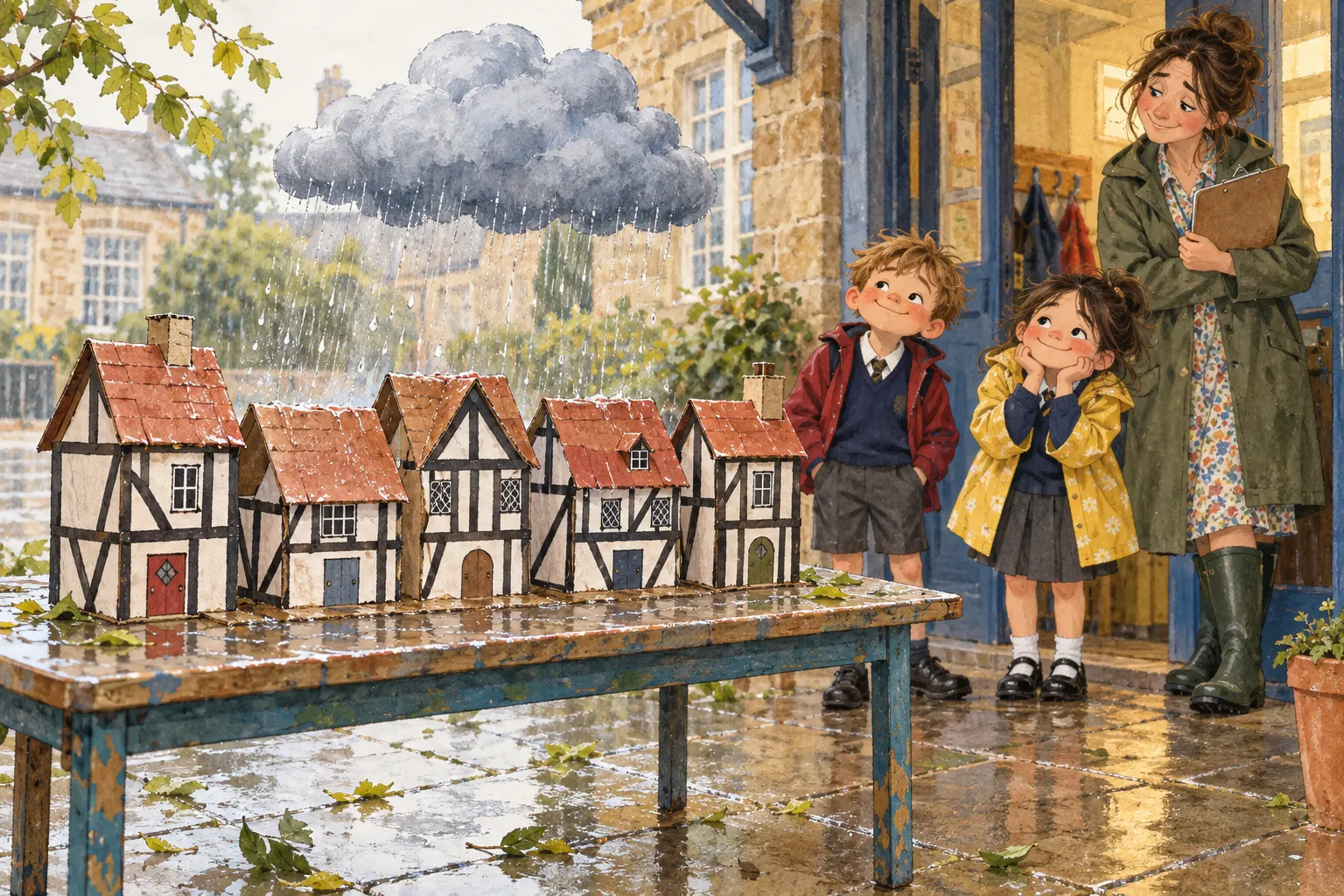
The Big Project sheet at Sir Henry Fermor, a primary in Crowborough, East Sussex, asks Year 2 families for a Tudor house “similar to that seen in London in 1666”, and then adds the most honest sentence ever printed on homework: “Make sure the material you use is flammable.” Most homework asks you to make something nice. This one asks you to make kindling, in period style.
I read the school’s archive the way other people read thrillers, because I have form. When our eldest did the Great Fire, I built a house of balsa and PVA and finished it with a varnish the tin described as fire-retardant. It did not burn. It is on our landing.
The plot, as the archive tells it. The sheet promises to recreate the fire, “culminating in a ‘Great Burn’ in the school grounds”, with a deadline of Monday 30 January. Then, on Friday 27 January 2023, the Year 2 weekly news thanks everyone who has brought in a house and extends the deadline to Thursday 2 February, “so a few more days to get creative!” A slight delay to 1666. I know what that weekend was in some kitchens. Somewhere a parent bought a second glue gun.
The burn makes the 3 February news. The children talk about how the fire started, what their models are made of and how the weather in September 1666 compares with today. Then they go outside, set the houses into streets of eight to ten, and wait. Not for long. By the end, “all that remained were the smouldering ashes.” Next, the class will recount the great burn “focusing on adverbs and past tenses”. A month of cardboard joinery, reduced to “quickly”.
Other schools are no slower. At Trimley St Martin in Suffolk in November 2015, firefighters helped Year 1 burn their Tudor houses, set close together with the wind behind them, and afterwards the children got to spray the hose and sit in the fire engine. At Farsley Springbank in West Yorkshire in May 2021, children built cereal-box houses along a narrow street, plus one large St Paul’s Cathedral, and the visitor running the day lit them with a flint and steel after a safety briefing. It was a very wet day. The fire took a while to get going and never reached the end of the street. Pudding Lane needed a baker’s oven. Leeds needed a dry day.
This term it is the youngest’s turn. His sheet came home on Monday and I was at the craft shop by four. My husband found me pricing balsa and read the line aloud, slowly, in the hallway, next to the house that did not burn.
We used a cereal box. It went up in about four minutes, and the youngest came home smelling of bonfire and delighted. His recount is due on Friday. I offered to help with the adverbs. He said yes, as long as I made sure the material I used was flammable.
Sources
- Sir Henry Fermor, archived Big Project homework requests
- Sir Henry Fermor, Year 2 weekly news, 27 January and 3 February 2023
- Trimley St Martin, London’s Burning, 24 November 2015
- Farsley Springbank, Great Fire of London workshop, 20 May 2021
Notes from the School Gates is a light-hearted column: home scenes and family characters are invented; schools and public facts are real. About the column