School portraits / Radio club, 1956–1964, with a later recollection
Contact With Alaska, Greenland and Malaya. Old Boys: Blackhall.
In 1956 the radio club at George Watson’s College could reach the far side of the world. Its own former pupils were proving harder to raise, and so is my son, who is upstairs.
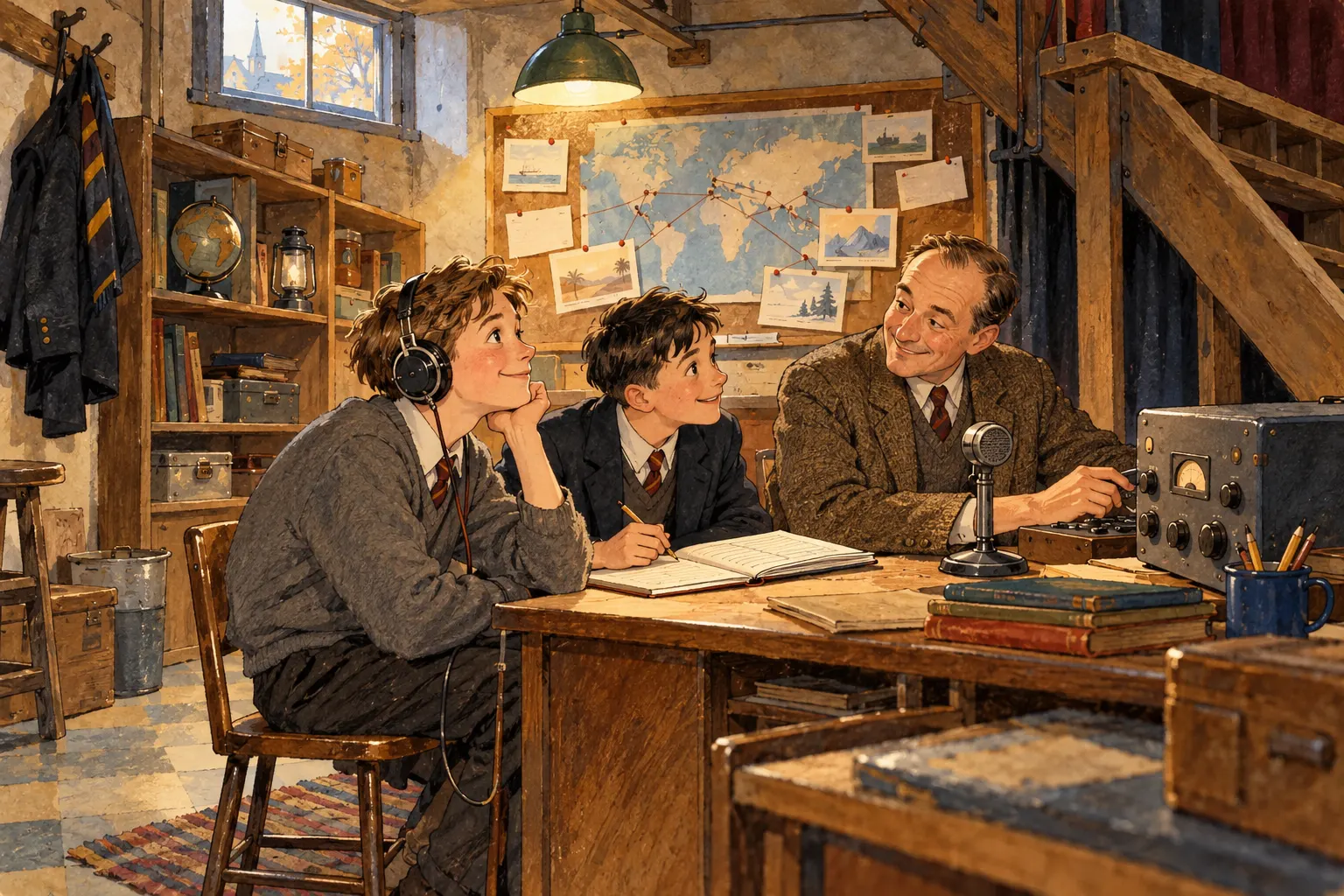
In May 1956 the radio club at George Watson’s College in Edinburgh reported to The Watsonian that its new transmitter, in use for about four months, had already made contact with Alaska, Greenland and Malaya. Then the bad news: “So far we have not established communication with a Watsonian any further away than Blackhall”. Blackhall is in Edinburgh. They had, the report added, raised one Herioter in London.
Heriot’s is the school down the road. All that transmitter, and the rivals picked up.
The report ends with a rallying cry, “Come on, ’Sonians!”, and I read it aloud in our kitchen with feeling, because our eldest is sixteen and upstairs. I can reach my cousin in Perth, Western Australia, on WhatsApp in forty seconds. I cannot reach a boy twelve feet above the extractor fan.
The Watson’s boys did not give up. The same report lists the kit with the pride of a car advert, a 150-watt transmitter and a V-beam aerial pointed at the United States, and hastens to reassure readers that the aerials are inconspicuous and do not spoil the look of the school. A year later the club was still asking old boys to send their QSL cards, the postcards radio amateurs swap to confirm a contact, and members were collecting scrap metal and wool to sell for a new beam aerial. Wool. The road to the old boys ran through other people’s jumpers.
Alan Masson, a member around 1960, remembers the station running every lunchtime from a room under the school stage. Tom Simpson, a teacher, built the equipment; John Hughes taught the theory. On a good day, Masson recalls, Australian stations could sound as if they were next door. The boy upstairs is actually next door, plus one floor, and sounds like Malaya.
The club’s final problem is a familiar one. Masson’s recollection ends with the former members in touch mostly by email and another reunion overdue. Decades of trying to raise the old boys, and they are now on the one network nobody answers.
I tried the 1956 method first. I sent “Come on, ’Sonians!” to the family group. My husband replied with a thumbs up from the sofa. The eldest read it at 6.02 and did not reply.
At 6.15 I switched off the router. He was in the kitchen by 6.16. Range: twelve feet. Watson’s had 150 watts and never got past Blackhall.
Sources
- The Watsonian, reports from the 1940s and 1950s, transcribed in the radio club archive
- Alan Masson, The Watson’s Radio Club, school-published former-pupil recollection
- The Watsonian, reports from the 1960s, transcribed in the radio club archive
Notes from the School Gates is a light-hearted column: home scenes and family characters are invented; schools and public facts are real. About the column