School portraits / One pupil research project, Summer Half 2018
Eton Boys Researched Their Own Lessons. Mine Researched Me.
Eton’s research journal shows pupils surveying classmates about how they are taught. I read it out at dinner as an example of initiative, which was a mistake.
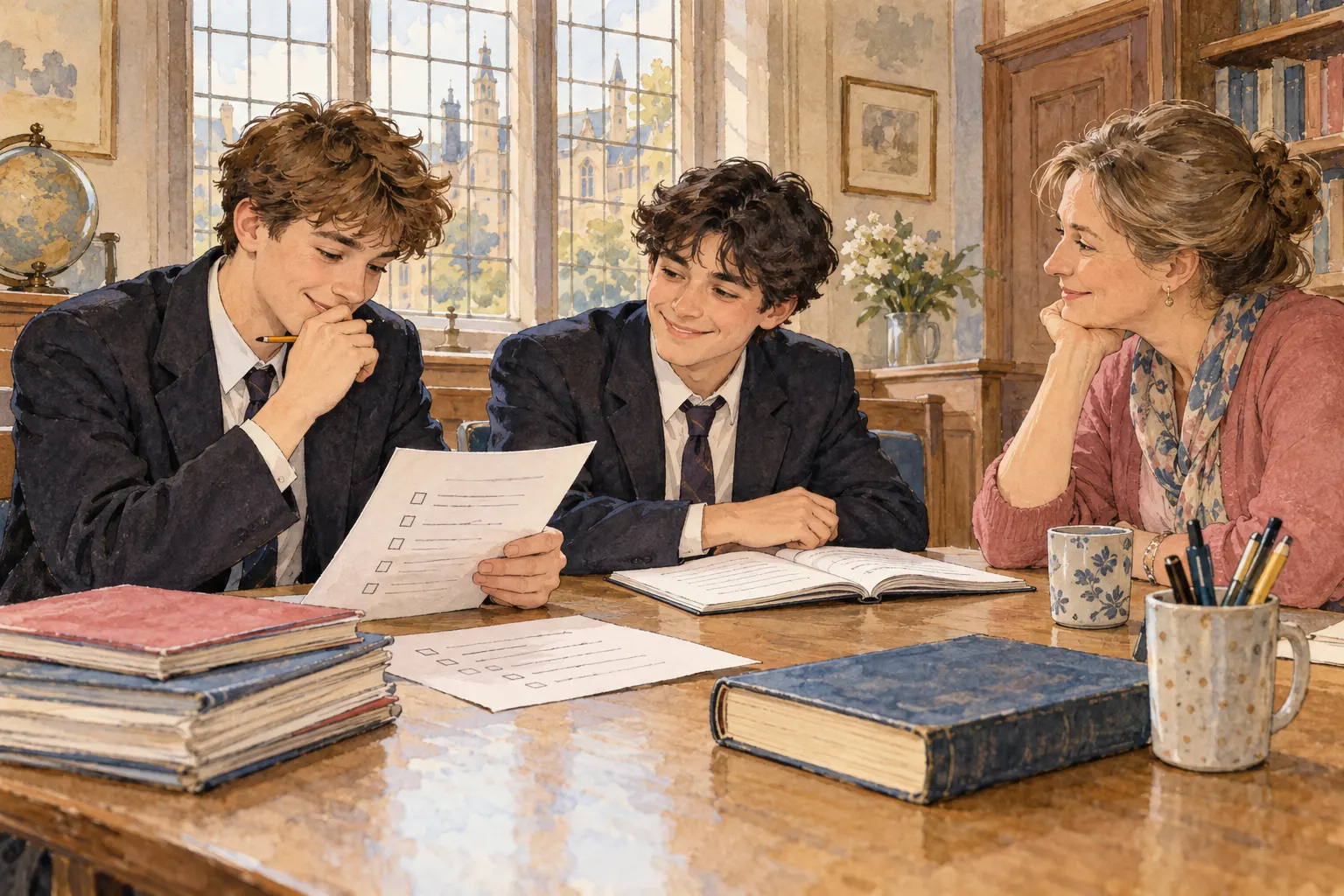
In June 2018 an Eton pupil explained in the school’s research journal why he wanted to study language lessons. He had been on a Spanish immersion programme, and the amount he improved in a week “completely dwarfed my rate of progress within a school setting.” He planned to take his findings to the Head of Modern Languages. I read this aloud at dinner as an example of initiative.
Our eldest, Archie, who is fourteen, said he would like to do the same about our house.
I said what a lovely idea.
I should have read further. The Spanish project came out of Eton’s Research Option, an optional course in which eight boys in their penultimate year learned to refine research questions, conduct interviews, design surveys and suggest interventions “on a school-wide level”. He was interviewing pupils who had become fluent in another language after birth. A year later a Year 12 boy surveyed 40 Economics pupils about setting by ability, and found that 47.5% had not noticed their classes were arranged differently from the rest of the school. One respondent wrote: “My effort level does not depend on what a number next to my schedule says.”
Archie built a Google Form. It was anonymous, in the sense that there are five of us and he knows everyone’s spelling. Its subject was the eleven-plus revision timetable I had drawn up for our youngest in September: colour-coded, half-hour blocks, a gold star column, laminated, on the fridge at eye level.
The results came in by Thursday. Two of the three children had not noticed the timetable had changed. I had laminated it. The third respondent asked which fridge. My husband’s answers were anonymous, and all of them were about biscuits.
Then the qualitative section. Our youngest, it emerged, had learned more vocabulary in one week of Scrabble at his grandmother’s in Margate than in a term of my half-hour blocks. Archie put this in a bar chart. The bar for Margate went off the slide.
He presented on Sunday, at the kitchen table, to the Head of Revision, who was me. He was courteous. He acknowledged that his sample was small and limited to one household. Like the Eton boy who studied sets, he concluded that a radical change would be ill-advised.
I thanked him, and changed the timetable that night. Nobody has noticed.
Sources
- Eton Journal for Innovation and Research in Education, Issue 1 — June 2018 (cover)
- Eton Journal for Innovation and Research in Education, Issue 2 — June 2019 (cover)
- Evidence-led Innovation — Undated current school page, accessed 30 September 2026
Notes from the School Gates is a light-hearted column: home scenes and family characters are invented; schools and public facts are real. About the column