The school archives / Summer term 1985; published on videodisc in November 1986
Eighty Dog Licences, One Saint’s Finger and a Water Fight
In 1985 a ten-year-old in Oxfordshire wrote her day down for the BBC’s new Domesday Book, and nobody cut a word. Then my daughter got the same homework, and I was in charge of the pen.
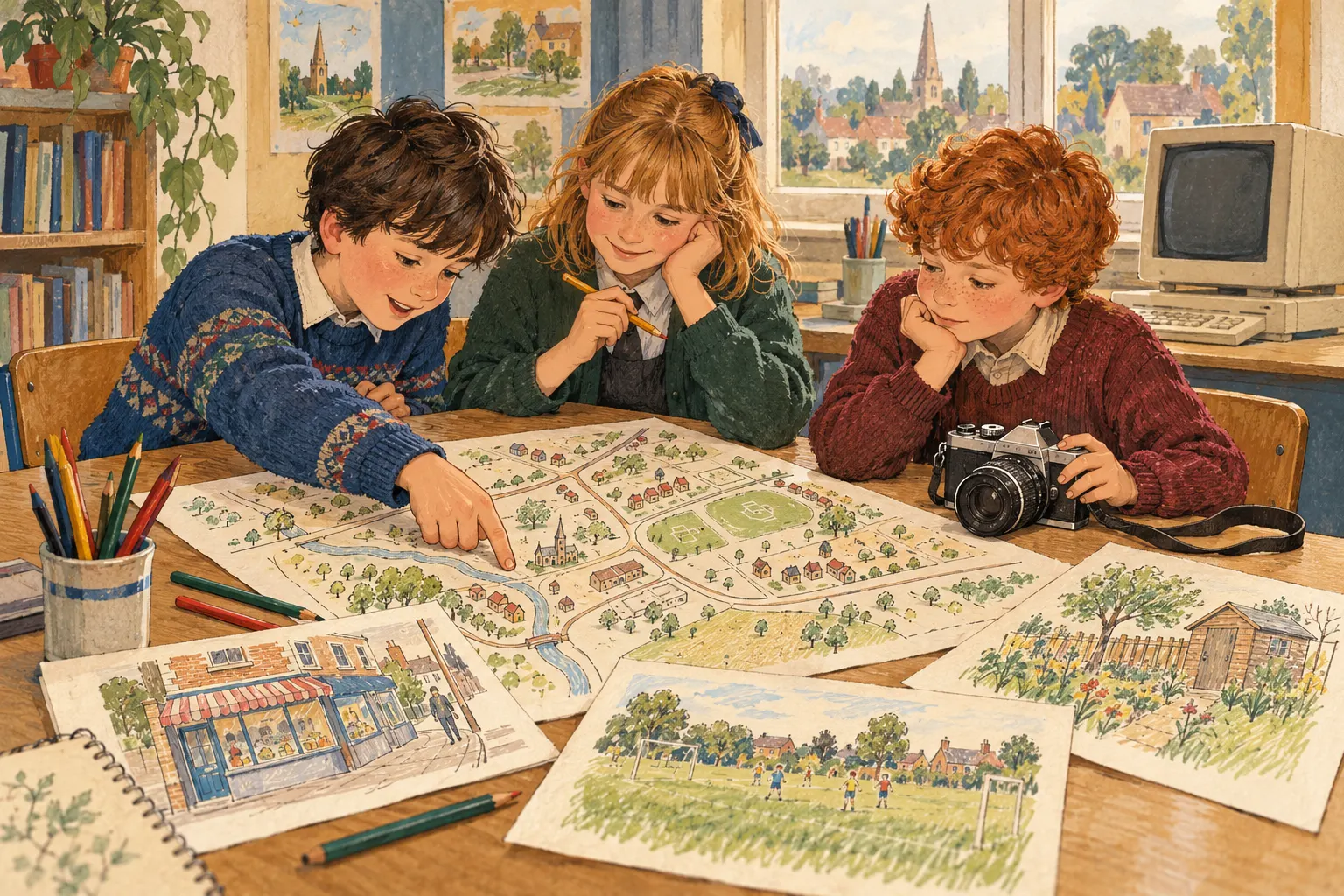
In the summer term of 1985 the BBC asked Britain’s schools to write a new Domesday Book, nine hundred years after the first, and some 9,000 of them said yes. Each took a patch of country four kilometres by three. The primary school at Stanford in the Vale, in Oxfordshire, did its patch properly: eighty people buy dog licences, 220,000 stamps are sold a year, and the church reliquary is “reputed to have held the finger of St Denys”. Then a ten-year-old wrote down her day, and somebody let her keep this: “after tea I have a water fight with my sister in the garden.”
Nobody tidied it. Andy Finney, one of the project’s founders, says the text was checked for legal reasons, but “no attempt was made to correct idiosyncratic spelling or grammar.” So posterity got the water fight. It also got “Maths. until break!”, which is the most honest sentence in the archive. The whole thing came out in November 1986 on two videodiscs that needed a BBC Master and a specially adapted player to read them, which is one way of making sure posterity really wants it.
Last month our daughter, who is ten, brought home a Year 6 homework called A Day in My Life. I had read the Stanford entry, so I knew what was at stake. This was going in a folder, and folders last. Her first draft said she woke up, had Coco Pops, did school, watched a man on YouTube open forty packets of football stickers, and went to bed. I asked whether that was really the day she wanted historians to have.
By draft two she was reading in bed from seven until half past, like the girl in Stanford, which is not a thing she does. By draft three she was practising the recorder after school, which she does not own. My husband asked for his shed to go in, on the grounds that he built it and it is still standing. The football stickers were cut. So was her brother. So was everything after tea, because after tea in our house is mostly shouting, and I did not see why the 2030s needed to know.
Stanford’s entry, meanwhile, notes in a level voice that the community bus tickets “are of special interest to collectors”. A school in Nottinghamshire told the BBC the child fare to Retford was 50p and that the area was sometimes boring. Nobody softened that either. The BBC had asked what local people thought was important, and the children, with no mother standing over them holding a biro, had told it.
The homework came back on Friday with a sticker and one comment in green pen, under the last line: “What happens after tea?”
That evening I filled the washing-up bowl, went out to the garden and lost, badly, to both of them. It is going in draft four.
Sources
- Stanford in the Vale: original BBC Domesday1986 contribution, community transcription
- Roberts Salkeld, BBC Domesday(Schools) Project invitation letter, before summer1985
- Rampton Primary School: BBC Domesday1986 Rampton&Woodbeck contribution, parish-council copy
- The Domesday Project:BBC collection newsletter, before summer1985
- Andy Finney, The BBC Domesday Project, co-founder’s account
Notes from the School Gates is a light-hearted column: home scenes and family characters are invented; schools and public facts are real. About the column